All Posts
Most long-distance moves cost in a range consistent with typical estimates, depending on distance, home size, and service level. The rule of thumb that keeps budgets from blowing up: take your base quote and add 20 to 35 percent for the line items movers rarely mention up front. Distance, weight, and how much labor you’re paying for drive nearly every dollar of the final bill.
TL;DR:
- Expect to pay between $5,000 and $15,000 for a realistic all-in long-distance move, with prices commonly increasing 20 to 35 percent from initial quotes.
- Moving costs vary based on home size, distance, weight, and service level, with a 3-bedroom household typically budgeting around $7,200 to $14,850 for 1,000 miles.
- Additional fees such as long-carry, stair, shuttle, specialty-item handling, and storage can significantly raise the final bill if not disclosed early.
- Request a binding, written estimate based on an in-home or video survey to avoid surprises and ensure accurate pricing.
- Choosing off-peak times, partial self-packing, and decluttering can reduce costs, while valuing adequate coverage protects against loss or damage.
Table of Contents
- What Does a Long Distance Moving Cost Actually Look Like?
- How Much Does a Move Cost by Home Size and Distance?
- What Are the Different Long Distance Moving Service Levels?
- What Add-On Fees Raise the Final Moving Bill?
- How Do You Get an Accurate Long Distance Moving Quote?
- What Are the Best Ways to Cut Long Distance Moving Costs?
- Do You Need Extra Valuation Coverage for a Long Distance Move?
- Sample All-In Budget: 3-Bedroom Move, 1,000 Miles
- Why Transparent Quotes Matter More Than the Lowest Number
- Ready for a Transparent Long Distance Moving Quote?
- Sources
What Does a Long Distance Moving Cost Actually Look Like?
Base quotes and final invoices rarely match, and that gap catches people off guard every moving season. HomeAdvisor puts the typical cross-country move between $2,389 and $6,866, averaging around $4,565. That number sounds manageable until specialty items, stairs, or a shuttle truck enter the picture.
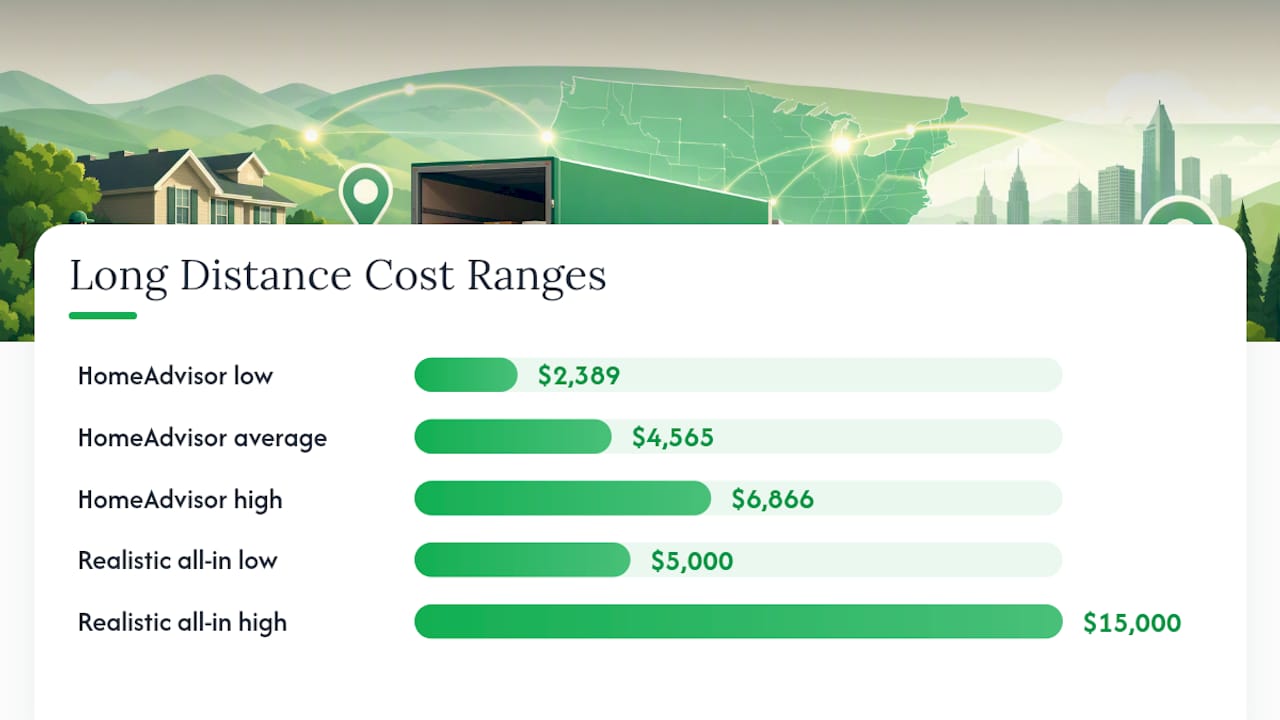
Industry cost studies covering a broader range of home sizes and distances peg realistic all-in totals between $5,000 and $15,000, with base quotes frequently understating the final bill by 20 to 35 percent. That’s not padding on the mover’s part. It reflects real costs: fuel, extra labor for access issues, packing materials, and valuation coverage that rarely show up on the first estimate you get over the phone.
Quick facts to anchor your budget:
- Average cross-country move: roughly $4,565, per HomeAdvisor’s cost data
- Realistic all-in range for most households: $5,000 to $15,000
- Typical uplift from base quote to final bill: 20 to 35 percent
- Primary cost drivers: distance, total weight or volume, and service level
Statistic callout: Plan around a base quote, then mentally set aside a significant additional portion above that number before you sign anything to cover line items. If your quote comes in at $6,000, budget closer to $7,800. Reviewing what actually drives your quote up or down before you call for estimates helps you spot padding versus legitimate charges.
How Much Does a Move Cost by Home Size and Distance?
Movers translate your home size into estimated weight, then multiply that by distance and per-pound rates. A one-bedroom apartment might weigh 2,000 to 3,000 pounds; a four-bedroom house can easily top 10,000 pounds. Here’s how that plays out across common distance bands.
| Home Size | 200 to 400 Miles | 400 to 1,000 Miles | 1,000–2,000 Miles | 2,000+ Miles |
|---|---|---|---|---|
| Studio / 1 Bedroom | $1,200 to $2,400 | $1,800 to $3,200 | $2,400 to $4,800 | $3,200 to $6,000 |
| 2 Bedroom | $2,200 to $4,500 | $3,000 to $5,800 | $3,800 to $7,500 | $4,800 to $9,500 |
| 3 Bedroom | $3,500 to $6,800 | $4,500 to $8,500 | $6,000–$11,000 | $7,500 to $14,000 |
| 4+ Bedroom | $5,500 to $10,000 | $7,000 to $12,500 | $9,000 to $16,000 | $11,000 and up |
Read the table by matching your bedroom count to the mileage band that fits your route, then treat the result as your base quote range, not your final number. A 3 bedroom household moving 1,000 miles lands around $6,000 to $11,000 before add ons. Apply the 20 to 35 percent uplift and you’re realistically budgeting $7,200 to $14,850 for that same move.
What Are the Different Long Distance Moving Service Levels?
Interstate movers price shipments by weight and mileage, typically landing around $0.50 to $0.80 per pound depending on distance and how much labor the job requires. Local, short moves usually get priced hourly instead. Once you’re crossing state lines, weight becomes the dominant variable.
Three service tiers cover most budgets:
- Self-load (truck rental): You drive, you load, you unload. Often runs in the low thousands for a cross-country trip, the cheapest option if your time and back can handle it.
- Container or pod services: A company drops a container, you load it, they drive it. Typically $700 to $5,000 depending on how many units you need and the distance covered.
- Full-service movers: Crews pack, load, drive, and unload everything. Full-service interstate moves commonly run $1,400 to $9,700, sometimes higher for large households with extensive inventories.
Hourly pricing rarely applies once you cross state lines. Budget by weight and distance instead.
What Add-On Fees Raise the Final Moving Bill?
These are the charges that turn a tidy quote into a surprising invoice. Each one exists because it reflects real extra labor or risk, and most reputable movers disclose them on your written estimate if you ask directly.
- Long-carry fees ($1 to $2 per foot): charged when the truck can’t park close to your door. Ask about parking access before booking to avoid this.
- Stair fees ($50 to $100 per flight, or a flat per-move charge): triggered when there’s no elevator. Confirm floor count during your survey.
- Shuttle fees ($400 to $1,000): needed when a large truck can’t reach a narrow street or rural driveway. Flag your address type early.
- Specialty-item handling: pianos, safes, and gym equipment often carry flat surcharges. Get these itemized, not bundled into “miscellaneous.”
- Storage-in-transit (roughly $1.50 to $3 per cubic foot per month): applies when your new home isn’t ready. Negotiate a grace period before charges start.
- Fuel surcharges and tolls: tied to national diesel prices tracked by the Energy Information Administration; ask whether your quote is fuel-inclusive.
- Tips: industry norms run $50 to $100 per crew member for a full day’s work.
Pro Tip: Ask your moving company for a written, itemized list of every possible add-on before moving day, not a verbal “it depends.” If a charge isn’t on that list, it shouldn’t appear on your invoice.
How Do You Get an Accurate Long Distance Moving Quote?
A phone estimate is a guess. A binding estimate, backed by an in-home or live-video survey, is a number you can hold a company to.
- Request a binding estimate, not a nonbinding one; binding quotes lock in the price based on a documented inventory, while nonbinding estimates can shift upward on moving day.
- Walk the surveyor through every room, including the garage, attic, and storage units. Moving.com notes that skipped items are the top reason final bills exceed quotes.
- Disclose stairs, narrow streets, HOA parking restrictions, and specialty items up front.
- Book six to eight weeks ahead for off-peak dates, longer during summer.
- Confirm move dates against peak season; a checklist like this multi-state moving guide helps you track what to disclose and when.
What Are the Best Ways to Cut Long Distance Moving Costs?
Timing and prep work save more money than haggling ever will.
- Move off-peak (September through April): can cut costs by roughly 15 to 25 percent compared to summer.
- Choose mid-month, weekday dates: consistently cheaper than end-of-month weekend slots.
- Partial self-pack: pack books, clothes, and non-fragile items yourself; save the crew’s time for furniture and fragiles.
- Declutter before the survey: every 100 pounds you don’t ship is money you don’t spend on weight-based pricing.
- Ship small valuables separately: jewelry, documents, and electronics travel safer and cheaper with you or via insured mail than on the truck.
Pro Tip: Don’t declutter your insurance along with your closet. Skipping a documented inventory to save time often costs more if something goes missing.
Do You Need Extra Valuation Coverage for a Long Distance Move?
Federal rules set a bare minimum: carriers must offer basic released-value protection, which pays out a small amount per pound regardless of an item’s actual worth, under FMCSA’s consumer protection guidance. That minimum won’t cover a damaged television or a scratched dining set.
- Federal baseline (released value): minimal cents-per-pound payout, essentially free but rarely adequate.
- Full-value protection: typically priced per $1,000 of declared value, often making it cost-effective for shipments worth more than a few thousand dollars.
- Statistic callout: On a $30,000 household shipment, full-value protection commonly adds a few hundred dollars, a small percentage against the total value it protects.
For most households, upgrading beyond the federal minimum is worth the modest premium.
Sample All-In Budget: 3-Bedroom Move, 1,000 Miles
Base quote: $8,000. Add stairs ($150), a long-carry fee ($200), specialty piano handling ($300), full-value protection ($350), and crew tips ($200), and you land near $9,200, a 15 percent lift. Budget the full 20 to 35 percent range and add a 5 to 10 percent contingency to stay safe.

Why Transparent Quotes Matter More Than the Lowest Number
The cheapest quote on paper is often the one with the most add-ons waiting behind it. We’ve built our process around binding, written estimates because a number you can trust beats a number that looks good for one phone call. Insist on a documented inventory before you sign with anyone.
— Inspirable
Ready for a Transparent Long Distance Moving Quote?
Wellesleymoving prices long-distance moves the way this article just told you to demand: binding written estimates, no deposit required, and a fully vetted crew, so the number you get quoted is the number you pay, not a floor that climbs after moving day.
Here’s what you get when you request a quote: a documented in-home or video survey, an itemized breakdown of every potential add-on before you book, specialty handling for pianos, lab equipment, and other sensitive items, and professional packing materials if you’d rather not box things yourself. Have your inventory, access details (stairs, parking, HOA restrictions), and preferred dates ready when you call. Get started with a long-distance moving quote and see the full number up front, not the one that shows up after the truck is already loaded.
Sources
For federal consumer protections, see FMCSA’s Protect Your Move guidance. For fuel cost context behind surcharges, see EIA fuel price data.
- Long-Distance Moving Cost Calculator 2026 by Size & Miles – Moving Crews
- How Much Does it Cost to Move Across the Country? 2025 Data – HomeAdvisor
- Moving
- FMCSA: Protect Your Move — Subpart D
Recommended
- Factors That Affect Moving Costs – Wellesley Moving Services
- How Much Does It Cost to Hire Movers in Massachusetts? (2026 Guide)
- All Posts Archives – Wellesley Moving Services
Made with BabyLoveGrowth tools