All Posts
Hire qualified movers for anything heavy, stair-bound, or headed onto a truck. DIY works only for short, ground-floor repositioning of a light, empty safe with the right rated equipment. Two quick checks settle it: estimate the safe’s weight, and count the stairs or elevator trips between here and there. If either number climbs, professionals like Wellesley Moving Services are the safer call.
TL;DR:
- Moving safes over 800 pounds or involving stairs, narrow landings, or uneven floors is best handled by professional movers to avoid damage and injury.
- Proper preparation includes emptying the safe completely, measuring dimensions, carefully unbolting, and protecting the safe with blankets and secure wrapping.
- Heavy safes require specialized equipment like low-profile split dollies, rated straps, and floor protection; DIY moves lack the stability and safety of professional gear.
- Moving a safe on stairs or tight landings demands motorized stair-climbing dollies or rigging, making professional assistance essential to prevent tipping or accidents.
- Long-distance or complex moves should always involve vetted professional services, with accurate measurements and photos to avoid unexpected costs or delays.
Table of Contents
- Gun Safe Moving: A Quick Checklist To Decide DIY vs. Pros
- How Do You Prepare A Gun Safe Before Moving It?
- What Equipment Do You Need To Move A Gun Safe?
- Step-By-Step: Moving A Gun Safe On A Flat, Ground-Floor Route
- Why Stairs Make Gun Safe Relocation A Job For Professionals
- What Drives The Cost Of Professional Gun Safe Movers?
- Bolting Down And Final Placement
- What I’ve Learned Watching Safe Moves Go Right (And Wrong)
- Get An Accurate Quote For Your Gun Safe Move
- Sources
Gun Safe Moving: A Quick Checklist To Decide DIY vs. Pros
Weight is the first filter. A lot of homeowners can wrestle a safe under roughly 800 pounds onto a rated dolly and roll it across a flat surface, but heavier units in the 1,000 to 1,600 pound range, common for full-size personal safes, usually call for a crew and specialized rigging, since entry-level safes run 200 to 600 pounds and commercial units can top 2,000.
Run through these before you commit to gun safe moving on your own:
- Weight: Check the manufacturer’s plate or manual for exact empty weight, not a guess.
- Stairs and doorways: Count every step, measure doorway width, and check elevator load limits if you have one.
- Floor type: Concrete slabs handle rolling loads far better than wood joists, which can flex or crack under a heavy safe.
- Building and insurance rules: Some condos and apartment buildings require a certificate of insurance for any heavy-item move.
- Distance: A move across state lines, or a rental truck company that bans loaded safes on its trucks, points straight to a professional carrier.
If two or more of these lean toward “risky,” skip the DIY route entirely.
How Do You Prepare A Gun Safe Before Moving It?
- Empty it completely. Remove every firearm, all ammunition, and any valuables, then inventory and secure them separately. Manufacturers and moving specialists consistently warn against moving a loaded safe, since the added weight shifts unpredictably and strains the frame.
- Measure everything. Get the full external dimensions, including door handles and hinges, then check diagonal clearance at every turn along your route.
- Unbolt carefully. If the safe is anchored, remove hardware slowly and bag and label every bolt. Photograph the base and mounting holes for reference.
- Wrap and protect. Cover the safe in moving blankets and secure them with stretch wrap. Never grab the handle or dial to pull or steady the safe. It’s not built to bear that kind of load.
Professional packing materials, the kind detailed on Wellesley Moving Services’ packing page, make this stage faster and reduce the odds of scuffed paint or a bent handle.
What Equipment Do You Need To Move A Gun Safe?
The tool that makes the biggest difference is the dolly itself. A standard appliance dolly works for lighter safes under a few hundred pounds, but anything heavier needs a safe-specific split dolly, sometimes called a no-lift, no-tilt system. This method ratchets the safe up about an inch and a half and rolls it on a low-profile track, which lets one or two people move a heavy safe without ever tipping it.
Round out the kit with:
- Ratchet straps, rated for the safe’s weight, cinched tight but not so tight they crush blanket padding.
- Moving blankets wrapped around corners and edges before any strap goes on.
- Floor protection, Masonite or plywood sheets laid along the entire route, plus furniture sliders for short pivots on hard flooring.
- A stair-climbing dolly or lift-gate truck rental when your move involves even a few steps or a loading dock.
Pro Tip: Skip the PVC pipe or golf-ball roller tricks you’ll find online. They tend to gouge flooring and offer zero control on an incline, and professionals rely on slick-stick tracks or motorized skates for exactly that reason.
Step-By-Step: Moving A Gun Safe On A Flat, Ground-Floor Route
This sequence applies only when your safe is empty, your route is flat, and your total weight sits comfortably within your dolly’s rating.
- Walk the route one more time. Clear rugs, close doors that swing into the path, and lay floor protection along the whole stretch.
- Strap the safe to the dolly. Center it, cinch the ratchet straps, and confirm the load sits balanced before you move an inch.
- Roll it slowly, upright. Keep the safe vertical the entire time. Manufacturers stress minimizing tilt to protect the locking mechanism, so tilt only if your dolly system is specifically designed for it.
- Use two people at every turn. One person guides the dolly, the other watches doorway clearance and calls out obstacles.
- Load with a rated ramp or lift gate. Check the ramp’s weight rating before you commit the safe’s full weight to it. Skipping that check risks damage to tailgates, ramps, and vehicle suspensions.
- Secure it inside the vehicle. Strap it to anchor points and block it against shifting with wood or heavy padding.
- Lower it carefully at the destination. Reverse the process, remove the dolly once it’s stable, and check that it sits level.
Most home safes in that 200 to 600 pound entry-level range are manageable this way in under an hour with two people and the right dolly.
Why Stairs Make Gun Safe Relocation A Job For Professionals
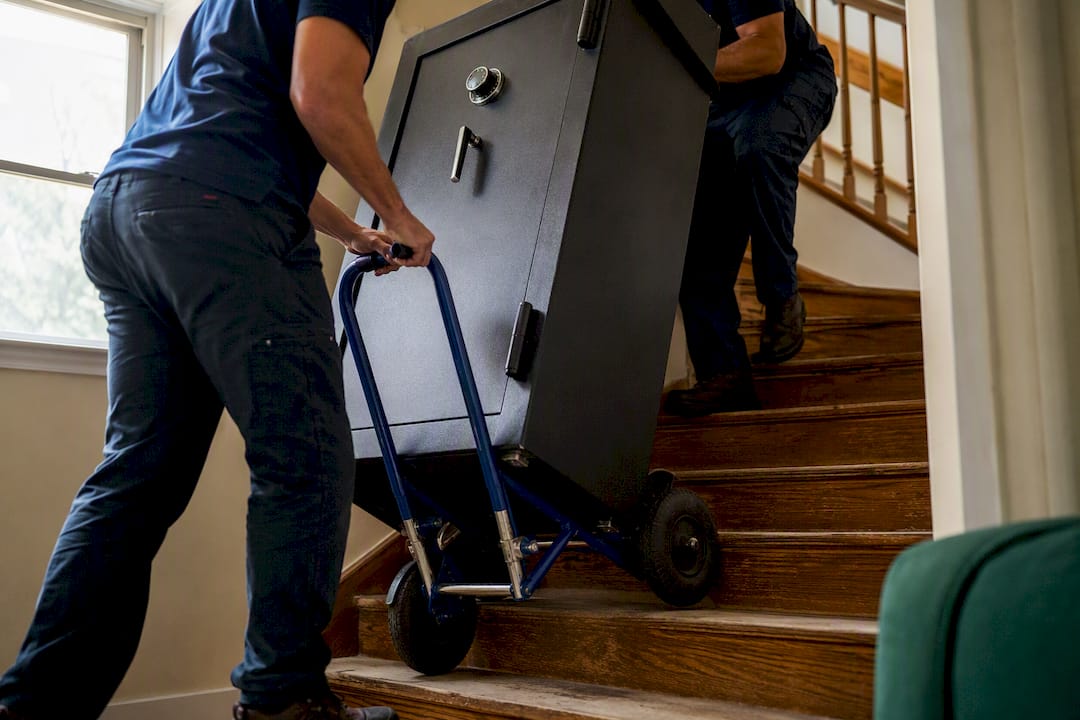
Stairs turn a manageable safe move into a genuine hazard. A safe shifting even a few inches on a landing can tip, and a few hundred pounds coming down on a foot or a stair tread does real damage. Narrow stairwells compound the risk because there’s no room to correct a bad angle mid-move.
Professionals handle this differently:
- Motorized stair-climbing dollies carry the load up or down at a controlled, steady pace.
- Rigging points and winches manage weight on landings where a dolly alone can’t hold the angle.
- Movers typically request photos and measurements before the job to confirm the crew, equipment, and insurance coverage match the job’s actual risk.
If your move involves stairs or a tight landing, that’s the line. Hire pros.
What Drives The Cost Of Professional Gun Safe Movers?
Weight and access complexity set the price more than anything else. A local move of a single mid-size safe with clear ground-floor access costs less than one folded into a household relocation, and both cost less than a long-distance haul requiring specialized equipment and extra crew.
| Move type | Typical cost drivers | What affects the quote most |
|---|---|---|
| Local, single safe, ground floor | Crew size, equipment rental | Weight, doorway clearance |
| Part of a full household move | Combined labor, truck space | Total inventory, distance |
| Long-distance or interstate | Fuel, crew time, specialized carrier | Distance, safe weight, access at both ends |
Send clear photos and exact measurements when you request a quote. It’s the fastest way to avoid a surprise add-on fee once the crew shows up and finds three flights of stairs nobody mentioned. Wellesley Moving Services’ cost factors page breaks down how these variables typically stack.
Bolting Down And Final Placement
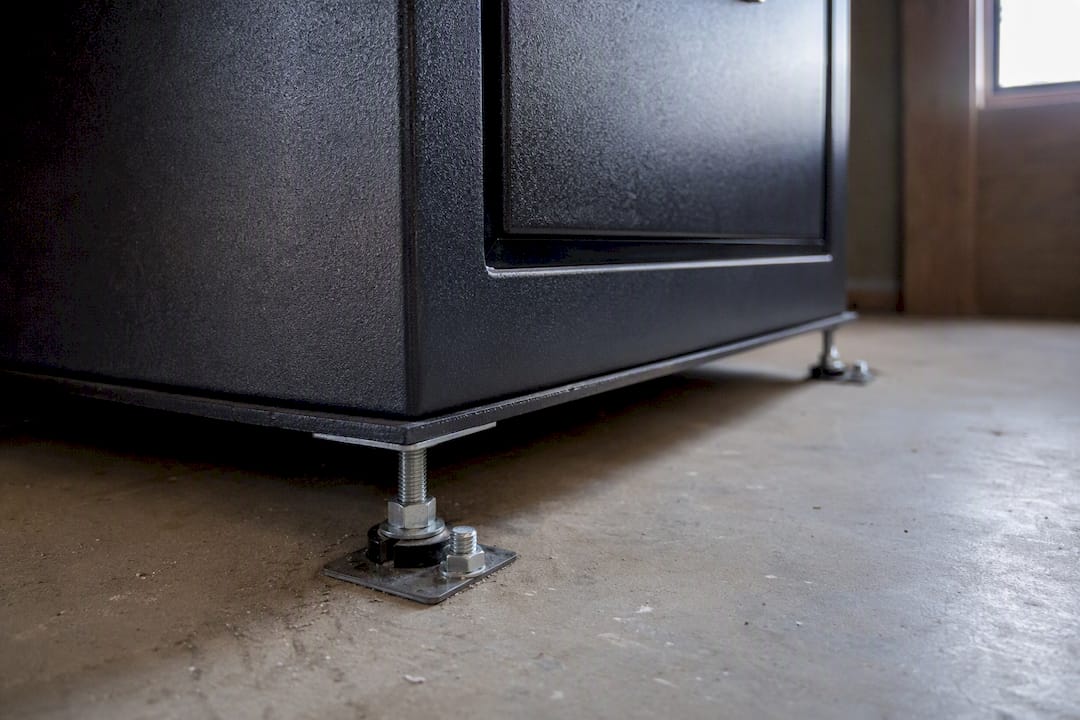
Once the safe sits where you want it, level it before anything else. A slightly uneven floor can throw off door alignment over time. On concrete, masonry anchors driven into the slab hold best; on wood subfloors, use lag bolts long enough to reach the joists, not just the surface plywood.
Test the door swing and lock mechanism once the safe is in place, and photograph the setup for your insurance records. Bolting matters most in earthquake-prone regions and any home with kids, since an anchored safe simply can’t be tipped or dragged away.
What I’ve Learned Watching Safe Moves Go Right (And Wrong)
The biggest misjudgment we see isn’t about strength. It’s about confidence outpacing preparation. Someone measures the safe but not the stairwell, or estimates weight from a spec sheet without confirming what’s actually inside during the load out. Wellesley Moving Services has handled specialty items long enough to know the failures rarely happen mid-lift. They happen at the planning stage, before anyone touches a strap.
If you’re on the fence, gather the basics first: photos from multiple angles, exact door and hallway measurements, and a real weight figure, not a guess. That packet alone gets you a far more accurate quote and a faster answer on whether your move is a DIY job or not.
— Inspirable
Get An Accurate Quote For Your Gun Safe Move
Wellesley Moving Services handles the exact scenarios this guide flags as “call a professional”: heavy safes, stairs, tight landings, and long-distance hauls. The advantage over piecing together rental equipment yourself is straightforward. You get a vetted crew, specialty packing materials suited to safes and other sensitive items, and no deposit required to lock in a date.
To get a precise quote, send over a few basics: photos of the safe and the route, an estimated weight, measurements of stairs and doorways, and your target moving dates. That’s enough for the team to price the job accurately instead of guessing on-site. Start your request through the Dover and Weston moving guide for local details, or check packing and specialty services if your move includes other delicate or high-value items alongside the safe.
Sources
- How to Move a Gun Safe — U-Haul
- Tips for Moving a Gun Safe on Your Own — Liberty Safe
- How to Move a Gun Safe by Yourself Without Lifting or Tilting — Clipdraw
- How to Move a Safe — Moving US Van Lines
Recommended
- Professional Movers in Dover, MA | Wellesley Moving Services
- Moving Packing Materials | Wellesley Moving Services
- Moving Inventory Process | Wellesley Moving Services
- Dover & Weston Moving Guide | Commercial vs Residential Movers
Created with BabyLoveGrowth to build website authority